
Jump to section
Use case highlights
The workflow below shows the management and analysis of in vivo data using Sonrai Discovery. The data was used to identify the most effective treatments for tumours and assess their safety profiles. Tumour samples were collected at different stages of the study, and both imaging (IHC) and omics (RNA sequencing) data were generated to explore the mechanisms of action of the therapy combinations.
Aligning efficacy studies with precision medicine
This use case shows a solution addressing operational inefficiencies in tumour volume analysis and data management, while also opening up new avenues in precision medicine. By aligning efficacy studies with precision medicine data, pharmaceutical companies are better equipped to develop more targeted therapies and support progress toward drug discovery.
Pharmaceutical companies in this phase encounter challenges such as inefficient tumour volume analysis, often hindered by basic tools like spreadsheets and standalone graphing software. Integrating diverse datasets from various Contract Research Organisations (CROs) adds further complexity, requiring accurate and consistent data management for early problem identification. There's also a need for efficient data cleaning and standardisation to reduce manual labour and errors, and high-quality reporting for internal decision-making and communication with external partners.
14% Reduction
Preclinical Phase
By accelerating target identification, validation and selection using AI insights integrated with diverse data sets.
x3
Increased Data Throughput
Through Sonrai's integration capabilities across multiple data modalities and real-time processing power.
62% Decrease
Manual Labor Required for Data Processing
Particularly relevant to automating data cleaning and standardization in tumor volume analysis.

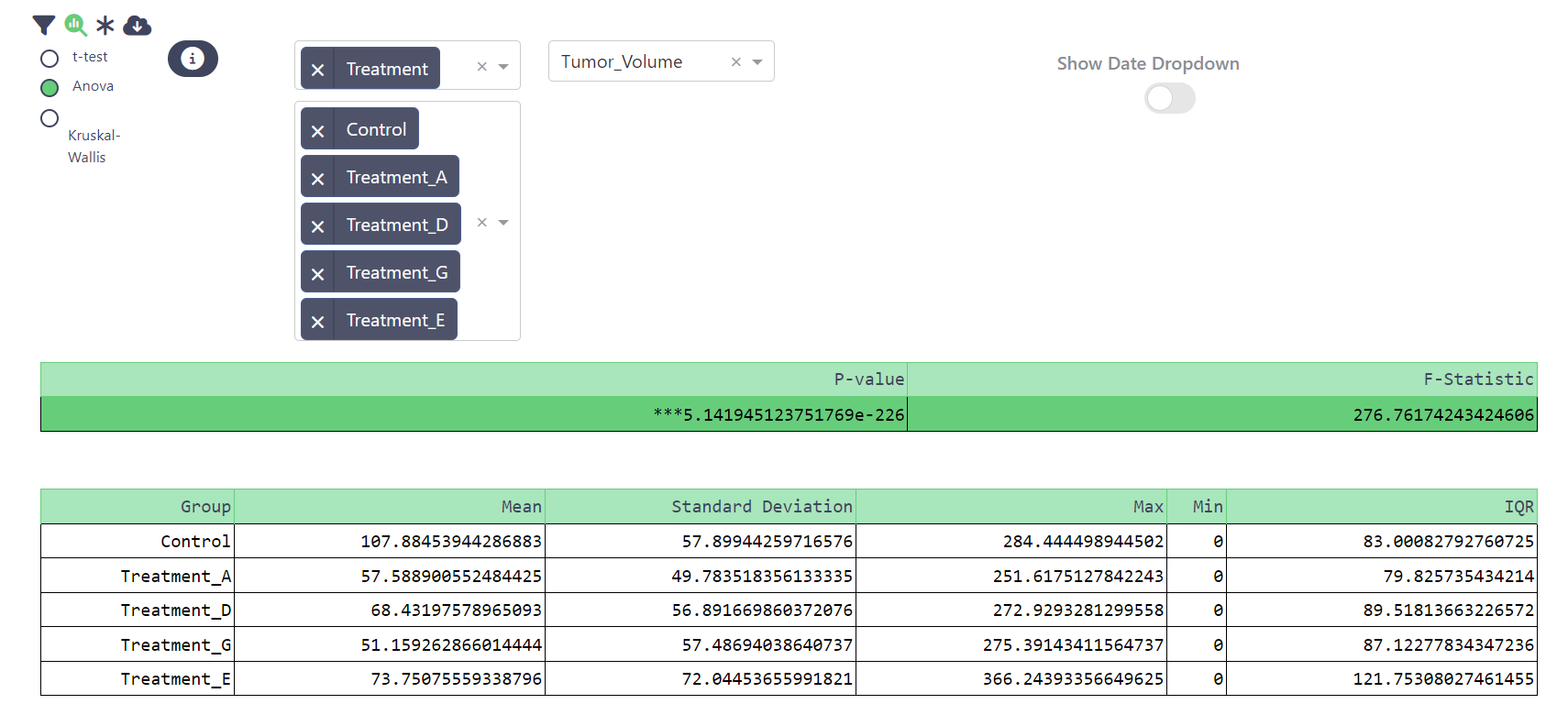


Step-by-step workflow for in vivo drug efficacy
Step 1: Data cleaning and formatting assessment
Sonrai Discovery eliminates the need for manual aggregation and reconciliation of data from multiple CROs — a process that traditionally consumes days or weeks and is prone to errors. Sonrai handles diverse data formats from various CROs by uploading data to the platform, identifying and resolving complexities and inconsistencies. This reduces the time and effort required for data harmonisation, letting pharmaceutical companies progress more quickly to data analysis and development activities.

24%
Error reduction
Minimising the need for rework and additional validation cycles, corresponding to Sonrai's capacity to resolve data complexities and inconsistencies effectively.
45% Reduction
Time spent on data handling
Eliminating manual aggregation and swiftly handling diverse data formats from various CROs.
Step 2: Enhanced data management
With the Sonrai Discovery pipeline in place, the frequency of incoming CRO data becomes less of a bottleneck. It integrates data as it arrives, on any schedule or in any batch, supporting consistent, automatic processing. This simplifies initial data handling and establishes a more error-resistant workflow.
Refining data management practices this way helps bolster the accuracy and consistency of tumour volume measurements — important for promptly identifying potential issues. Real-time data monitoring and analysis gives teams more immediate access to processed data, supporting swifter decision-making as issues arise, and helps manage more simultaneous projects or studies in parallel.

x3
Throughput of data analysis operations
Step 3: Development of custom data processing tools
Working closely with users, Sonrai Discovery builds a custom workflow for tumour volume analysis, featuring automated data cleaning and standardisation — particularly relevant to automating these steps in tumour volume analysis specifically. This personalised approach reduces analysis turnaround time and adapts to project-specific needs.
62% Decrease
Manual labour required for data processing
40% Reduction
Setup and adaptation time for new methodologies
Step 4: Advanced variables analysis
Sonrai Discovery enables comprehensive analysis of variables such as drug dosage, tumour growth, response data (e.g. RECIST criteria) and biomarker levels. This analysis provides a detailed view of the drug's impact, aiding in the nuanced understanding of treatment effects.
48% Reduction
Time required for complex data analysis
33% Improvement
Predictive accuracy of treatment outcomes
"With Sonrai's advanced AI-driven platform, we anticipate ongoing data handling and error reduction improvements. Their custom data processing tools have significantly streamlined our workflows, and we expect these efficiencies to grow as we expand our precision medicine initiatives."
Step 5: Toxicity assessment
Using Sonrai's analytics, toxicity thresholds are established to inform dosing regimens, balancing efficacy and safety. Systematic monitoring of mouse weights offers data on drug side effects and efficacy. Data processing, visualisation and analysis of animal pharmacology and toxicology studies supported more efficient IND applications.
51% Reduction
Time to data ready for IND submission
45% Reduction
Time spent on data handling
Step 6: Enhanced reporting capabilities
Sonrai Discovery enables the rapid generation of comprehensive reports, streamlining communication with internal teams and external partners and simplifying the presentation and sharing of critical findings.


49% Reduction
Report costs
Improved efficiencies
Time spent on data handling, via a centralised data integration platform
Results
Through Sonrai's AI-powered analytics on in vivo imaging data from mouse models, the collaboration also achieved:
Collaboration Time Savings
Reduced time for collaborative processes with CROs — streamlined communication and data exchange contributed to a 40% reduction in setup and adaptation time for research.
Tumour Volume Measurements
Adapting to project-specific needs and advanced visualisation capabilities supported more accurate and consistent measurements.
Decreased Manual Data Analysis
Automation and better data management significantly reduced time spent on manual data sorting, cleaning and initial analysis — a 62% decrease in manual labour required for data processing.
Increased Project Throughput
Enhanced data integration and workflow automation increased the number of projects simultaneously managed with CROs, supporting more parallel processing.
Related Case Studies
Like what you see? Let's talk
We listen to your problems, and give you the confidence to make your decision.
Take the first step